
Everettian chance in no uncertain terms
We unify Everettian accounts of chance by focusing on the conditions under which branches are isolated.


We unify Everettian accounts of chance by focusing on the conditions under which branches are isolated.

We discuss how quantum interpretations elucidate conceptual resources that can be useful for pedagogy.

We explore the basic formalism of quantum mechanics alongside several prominent interpretations of it.


We discuss how quantum interpretations elucidate conceptual resources that can be useful for pedagogy.

We unify Everettian accounts of chance by focusing on the conditions under which branches are isolated.

We unify Everettian accounts of chance by focusing on the conditions under which branches are isolated.

This project, a collaboration with Rachel E. Scherr, investigates how the intersection of physics and philosophy can benefit upper-level physics education. We draw on feminist …

We argue that teaching physics undergraduates different approaches to quantum measurement might bring their epistemologies closer to those of experts.
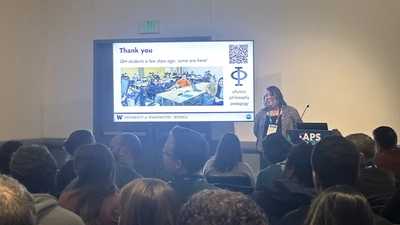
We identify conceptual resources that reflect specific quantum interpretations and explore their potential for supporting specific learning goals in quantum mechanics.

Hypothetical frequencies are great approximations (inexact descriptions of a target) but bad idealizations (separate models that bear analogies to the target).